Have rice and eggs anytime

I admit that this week’s recipe was one of those where I just happened to have all the ingredients in the house, and so had the perfect excuse to make it.

Even easier to do as it was another of the Jamie Oliver 5 Ingredients recipes, so I literally only needed to have 5 ingredients (plus salt and water) on hand, most of them household staples for us.

Now, not all ingredients will be household staples for most. I’m just lucky that my sweetie has been doing the shopping for us since the pandemic began and has been adding a stop at the local Asian market to his errands while he’s out. That’s how we came to have kimchi available any time.

While the Korean eggs and rice dish is, of course, Korean, it’s also possible to replace the kimchi with another vegetable. Kimchi worked really well with the cilantro as well, but again, anyone could use a different herb or spice accompaniment.

Korean eggs and rice ingredients.

I might recommend giving kimchi a try, though, as the fermented cabbage is quite a bit tastier than its name or its description might make it seem.

This is the second time I’ve made the dish and I’ve stuck to the recipe both times, other than the fact that I’ve used a smaller skillet than called for and increased the cilantro amounts. It’s been fine, though I’ve never quite managed to get the eggs to fully encompass the rice; I think next time I’ll just go ahead and stir it in a bit rather than hoping it wraps around. However, it does still taste great and does allow the rice to crisp a little more, which I enjoy quite a bit.

The meal also delightfully works as both breakfast and dinner. All around a nice, easy meal when you don’t have a lot of time or the energy to make something too difficult.

Looks good, don’t it.

Here’s what I did:

Ingredients

  • 1 T. sesame seeds (I didn’t really measure so definitely used more)
  • 150 g. basmati rice
  • 150 g. kimchi
  • 8 sprigs of cilantro
  • 4 eggs
  • Salt, to taste
  • 400 ml water

Directions 

Toast sesame seeds in a 9- to 10-inch skillet over medium heat. Once lightly golden, remove to a plate, and reduce heat to medium-low. Place the rice in a pan with a pinch of salt, and then pour in 400 ml of water. Cover and cook the rice for 10 to 15 minutes until the rice has absorbed all the liquid.

Meanwhile, chop the kimchi and tear up half the cilantro, and place in a medium bowl. Beat in the eggs, and then pour over the rice when it’s ready, spreading evenly with a spatula. Cover and cook for another 10 minutes or so until the eggs are just set.

Loosen the edges with a spatula, and then slide it out on a plate. Scatter the sesame seeds on top and then place the remaining cilantro leaves on top, and enjoy!

Bless you, bing bread

As I scoured for recipes that may work in my little Le Creuset, I was so grateful to come across the first one that I noticed that specified an exact size for a skillet. Now, sure, it said 10 inches, but 9 inches is close enough for comfort.

So, I tried my hand at bing bread.

Bing bread ingredients.

In addition to its specified size, it is bread (good) stuffed with potatoes (good), scallions (good), bacon (amazing), and cheese (amazing), and then slightly fried and also baked. It was also supposed to incorporate sesame oil, which I love, but I forgot to put it in the rolled-up dough, and stupidly thought it’d be OK to add it with the frying oil. Don’t do that. It didn’t ruin it, but it didn’t help any either.

If I make it again, and I will make it again, I will be remembering to brush the dough with sesame oil and skimping on the frying oil. Also, I need to remember that a smaller pan is going to reduce cooking time.

Since this makes two bread rounds, I was lazy and made one in my Le Creuset and the other in the 10-inch Lodge skillet, and (I am loathe to admit) the larger pan definitely worked better. However, I think it’s mainly because I failed to account for the fact that smaller pans could cook faster.

While the fried side of both definitely looked a bit charred, they both ended up tasting just fine. I think the extra oil mostly made the edges a little chewier, but it didn’t taste burnt at all. Proof that presentation isn’t everything, especially when you have bacon and can top it with sour cream butter.

Deliciously decadent. And not too burnt.

Here’s what I did, following the thankfully specific Bon Appetit recipe:

Ingredients

  • 2 ¼ t. active dry yeast (1 package)
  • 2 T. plus 2 t. honey, divided
  • 2 ½ t. salt, divided
  • 2 c. plus 2 T. warm water, divided
  • 4 c. all-purpose flour, plus more for coating
  • 1 large potato, baked and diced
  • 3 T. vegetable oil, divided
  • 1 lb. bacon, cooked (I baked mine on a grate) and diced
  • 2 T. toasted sesame oil, divided (sort of optional since I mostly forgot, but it is delicious)
  • 8 oz. white cheddar, grated (about 2 c.)
  • 1 bunch scallions, thinly sliced
  • 1 T. soy sauce
  • 2 T. sesame seeds, divided

For sour cream butter (not strictly necessary but recommended)

  • 1 stick butter, room temperature
  • 2 T. sour cream
  • Scant 1 t. salt

Directions

Combine the yeast with the 2 T. honey, 2 t. salt, and 2 c. warm water in a large bowl, and whisk to dissolve the honey. Let sit until the yeast activates and becomes foamy, 5 to 10 minutes. Add 3 c. of water and mix with a wooden spoon until a dough begins to form, adding flour (up to about another cup) until a shaggy ball begins to form. Cover and let rise until doubled, about 50 to 70 minutes.

Meanwhile, prepare the bacon and potatoes if you haven’t already (I did mine early and just chopped while I waited). Also, while waiting, whisk together the soy sauce, 2 t. honey, and 2 T. water in a small bowl until the honey is dissolved.

Heat oven to 400 degrees.

Once dough has doubled in size, gently push it down and transfer to a floured surface, kneading and adding flour as necessary until a sticky, smooth dough is formed. Divide the dough in half, and cover one half in plastic wrap so it doesn’t dry out while you prepare the first.

Roll out the half of a dough into about a 13-inch round that’s about ¼ inch thick. Brush with 1 T. sesame oil (don’t forget!), and then sprinkle on the round half the potato, bacon, cheese, and scallions. Roll dough up like a jelly roll, and then pinch ends and seams together to seal. Then, squeeze and press from the center toward the ends to elongate the roll slightly and even out the thickness. Then, starting from one end, coil like a rope to form a large spiral. Flatten the spiral to form a 9-inch round.

Cover the round and repeat with the remaining dough, using up the rest of the sesame oil, potato, bacon, cheese, and scallion.

Heat a 9- to 10-inch cast iron skillet over medium heat. Add 1 T. vegetable oil, swirling to coat. Carefully place one spiral in the hot skillet, and brush with the soy glaze. Cover with lid (or aluminum foil) and cook until the underside is golden brown between 5 and 10 minutes. Uncover and carefully flip bread over. Brush the browned top with soy glaze and sprinkle with 1 T. sesame seeds. Transfer to oven and cook, uncovered, until underside is also golden brown, about 15 minutes. Remove to wire rack and let cool 15 minutes.

Repeat with second round (or use 2 9- to 10-inch skillets), and don’t forget the glaze and seeds. Once cooled, cut into wedges and serve with sour cream butter, which can be made ahead, and enjoy! To make butter, whisk 1 stick room temperature butter, 2 T. sour cream, and scant 1 t. salt.

You do udon

I’m slowly getting back into the groove of things since being back from vacation. I imagined it would be quicker but exhaustion got the better of me as did the daily grind.

So I decided to start back up with the kind of weeknight dinner that takes little effort and barely follows a recipe. I went with udon noodles with chicken and broccoli, or the more vague “Asian noodles,” which was the not-the-most-culturally-sensitive Google search I did to get the vague idea of ingredients for a sauce.

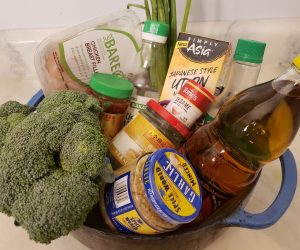
Udon noodles ingredients.

That blog post, like my own, makes clear that this recipe can be adapted to anyone’s tastes. Don’t like broccoli? Try carrots or spinach or a combination of veggies. Want to add peppers? Go ahead. Don’t want chicken or are vegetarian? Skip it or add tofu.

The same is essentially true of the sauce. I went heavy on the sesame oil because I love it and I have it. I also added a bunch of ginger (from a jar because I was lazy) that wasn’t in the recipe; I just like a lot of ginger. I skipped out on the cilantro to save my sweetie, but I think it would have been pretty tasty as an addition.

That’s to say, you do udon.

To hurry things along, I cooked the udon separately while I prepared the chicken, vegetables, and sauce, but if you’re in no rush and want this to be a one-pot dish, you can cook the noodles in the Dutch oven and leave to drain while preparing the rest of the dish.

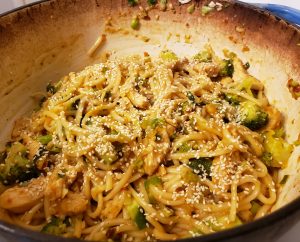
I still want more; it disappeared too fast.

Here’s what I did:

Ingredients

  • 14 oz. udon noodles, cooked to package directions
  • 1 lb. chicken, sliced or chopped
  • 3 c. broccoli (or about one grocery store package with 2 to 3 heads), chopped
  • 1 bunch green onions, white and light green parts sliced
  • ⅓ to ½ c. soy sauce (less sodium is good)
  • ¼ c. toasted sesame oil
  • 1 ½ T. ginger, minced (I used the jar stuff)
  • 3 cloves garlic, minced
  • 1 T. rice vinegar
  • Sambal oelek (chili paste), or Sriracha, to taste (I used about ½ T.)
  • 3 T. sesame seeds
  • Vegetable oil, for sauteing

Directions

Heat the oil in the Dutch oven over medium heat, and saute the chicken until mostly cooked through before adding the broccoli and green onions, stirring occasionally. Meanwhile, mix together the soy sauce, sesame oil, ginger, garlic, rice vinegar, and sambal oelek or sriracha, and stir to combine.

Once the chicken is cooked through and the vegetables are cooked to desired consistency, turn off stove top and add the sauce. Stir to combine and then add the cooked noodles, and continue stirring. Remove from heat and add the sesame seeds, stirring again. Taste and add more soy sauce or sesame oil as desired, and enjoy!

Chickity China the Chinese chicken

I like cheese way too much to make Asian food a staple of my diet. But it’s great to occasionally expand my palate and eat (somewhat) healthier fare. So, that is how I came to have a wide variety of Asian condiments in fridge door.

This week’s recipe thankfully allowed me to use so many of them and not add to my collection. I had bought some chicken thighs a weekend earlier when I made my venture to Whole Foods for seafood, so my purchases for this one amounted to three items.

Cauliflower, a sweet potato, and a red pepper were all it took to complete the sheet pan hoisin sriracha chicken recipe I had found a few weeks earlier from Taste of Home.

Hoisin sriracha chicken ingredients.

I mostly followed the recipe, except I’m lazy and used boneless, skinless chicken thighs. I might have added more sriracha because I didn’t measure it but it was damn spicy so add carefully or taste the sauce before pouring on the meat and vegetables.

I have to say I enjoyed it thoroughly, but my favorite thing was perhaps just how simply it came together.

I made it when we had the “fake fall” this past weekend, so I prepped the vegetables, made the sauce, and then sat in front of our firepit for a while before coming back to put it all together. About 45 minutes later, we had dinner, and a couple days worth of leftovers.

Don’t let the cauliflower fool you, this meal is flavorful and delicious.

Here’s what I did:

Ingredients

  • ⅓ c. hoisin sauce
  • ⅓ c. soy sauce (preferably low-sodium but we had regular on hand)
  • 2 T. honey
  • 2 T. sriracha (I didn’t measure but perhaps it’s best to measure on your taste for spicy foods)
  • 1 T. rice vinegar (I was out of rice wine vinegar, which I planned to use, so I used apple cider vinegar)
  • 2 t. sesame oil (I definitely used more but I love sesame oil)
  • 2 cloves garlic, minced
  • 1 t. minced fresh ginger
  • 6 boneless, skinless chicken thighs
  • Salt and pepper, to taste
  • 1 medium sweet potato, cut into cubes
  • 4 c. fresh cauliflower, cut into bite-size pieces
  • 1 red bell pepper, chopped
  • Sesame seeds, optional for topping
  • Oil for coating

Directions

Heat oven to 400 degrees.

Mix together the first eight ingredients, the hoisin sauce through the ginger, in a small bowl. Line a large rimmed sheet pan with aluminum foil and coat with a layer of oil (I use the spray kind). Place the sweet potato and chicken on prepared sheet pan, and add salt and pepper to taste.

Brush on about ⅓ of the hoisin sauce mixture.

Bake for about 15 minutes. Add the cauliflower and red pepper, and brush on another ⅓ of the hoisin mixture.

Bake another 25 to 30 minutes longer, until the chicken is cooked through. Brush on the remaining sauce, add the sesame seeds  (if using), and enjoy!

Everything sucks about these everything bagel crackers

I’ve been wanting to make this week’s recipe for a few years now, ever since I spent a year making breads. Somehow these crackers never made the cut, but I’ve saved the link to the recipe for a time when I had the chance to make them.

Of course, I’ve had opportunities but when you like to make food as much as I do, the list of things you wish to make — while still making time for old favorites — is quite long.

But, still, these are everything bagel crackers. Everything bagels were my first and favorite bagel love.

Everything bagel crackers ingredients. If you dare to make them.

If I’m only getting a single bagel, it will be an everything bagel (with a plain shmear, if you’re wondering). If I’m getting a dozen, a quarter to half of them will be everything. Almost all of the remainder will be one of the toppings from an everything bagel — poppy seed, sesame seed, garlic, maybe onion. I might make an addition of an asiago.

Point is, it’s a little weird I haven’t made these crackers yet.

So, even though I didn’t have a lot of time this week, I love to make bread and I thought this was the perfect week to finally whip together this treat.

It didn’t go well from the start, which should have been a sign.

Most of it was my fault. I had to go get some ingredients so I got off to a late start; it went more slowly than I had anticipated; I misread the directions slightly so I got even more flustered; and it made more of a mess in our already messy kitchen than I had hoped.

But not all hope was lost. After all, these were topped with “everything.” It’d all work out.

And initial signs indicated it’d be OK. The first few that crisped at the edges got taken out a little early while the rest baked, and after slight cooling, they tasted pretty good.

Then, when I was putting them away, my spirits got totally crushed and I’ve vowed to get revenge on this recipe if it’s the last thing I do (OK, not really, I’m just feeling dramatic.).

The parchment paper lining, I thought, made for an easy way to wiggle the crackers into a Ziploc bag for safe storage.

But when I poured, all of the topping mix just came right off the crackers and sunk to the bottom of the bag.

The only thing that made them good sat in a layer so so so far away from the crackers. I could have saved the effort of brushing the crackers with oil and carefully sprinkling on the topping mix, and instead just dumped them on some plain wheat crackers.

A second batch was placed more carefully but it only salvaged a couple of poppy seeds. Plus, who wants to make crackers that have to stay right-side up for their toppings to stay on?

Ugh.

As for the crackers, they were merely OK. The salt stayed on, which meh. Mostly, I made it work by pouring the topping mix onto hummus and then scooping up everything hummus onto plain wheat crackers.

If you’re still brave enough to make this recipe after my rant, and not dissuaded, I do have two thoughts to make it work. First, mix the everything topping mixture *into* the cracker dough, or do most of it in the dough and sprinkle on some, and then *press* it into the dough with wax paper or more parchment paper. Second, just do it all on top, but *press* it into the dough.

Me, I’m just going to hit up an Einstein’s or make the mix and put it on something else.

They look pretty good, sure. But if you turn them upside down, that topping just slides right off.

Here’s what I did, mostly following a recipe from The Chew:

Ingredients

For the crackers

  • 2 c. all-purpose flour
  • 2 c. whole wheat flour
  • 2 t. sugar
  • 1 t. salt
  • 1 ¼ c. water
  • 5 ½ T. olive oil (plus more for brushing if you put the topping mix on top)

For the topping mix

  • 2 t. dried minced onion, or onion flakes
  • 2 t. dried minced garlic, or garlic flakes
  • 2 t. poppy seeds
  • 2 t. sesame seeds
  • 2 t. Kosher salt
  • 1 t. caraway seeds (optional)
  • 1 t. fennel seeds (optional)
  • 1 t. black sesame seeds (optional)

Directions

Heat oven to 375 degrees.

Line two large rimmed sheet pans with parchment paper.

In a large bowl, mix together the flours, sugar and salt. Stir in the oil and water. Mix together until well incorporated. (Add the topping mix here, if desired.) Turn out dough onto a lightly floured surface and knead to combine completely, without overworking the dough.

Divide the dough into three discs and cover two with plastic.

Roll one disc at a time to ⅛ inch thickness, and then cut into 2” pieces. (The recipe says to cut into triangles but TBH, I couldn’t figure out how to make discs make triangles of that size without a lot of effort. I thought at first cutting like a pizza but they were too big.)

Transfer the pieces to the parchment paper-lined sheet pan. (Here’s where I misread. The recipe has you do this in batches so you do one disc, bake, then the next disc. I missed that, but I’d rather get it done quicker by fitting it all on 2 sheet pans and baking at the same time.)

Repeat with the next two discs.

Just before baking, brush the triangles (or whatever) with oil and top with topping mix. PRESS into the dough.

Bake for 30 to 35 minutes until crispy.

Let cool completely, and try to enjoy!