You do udon

I’m slowly getting back into the groove of things since being back from vacation. I imagined it would be quicker but exhaustion got the better of me as did the daily grind.

So I decided to start back up with the kind of weeknight dinner that takes little effort and barely follows a recipe. I went with udon noodles with chicken and broccoli, or the more vague “Asian noodles,” which was the not-the-most-culturally-sensitive Google search I did to get the vague idea of ingredients for a sauce.
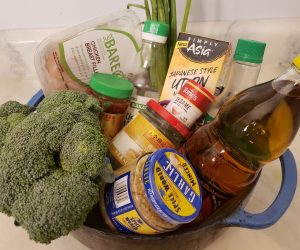
Udon noodles ingredients.

That blog post, like my own, makes clear that this recipe can be adapted to anyone’s tastes. Don’t like broccoli? Try carrots or spinach or a combination of veggies. Want to add peppers? Go ahead. Don’t want chicken or are vegetarian? Skip it or add tofu.

The same is essentially true of the sauce. I went heavy on the sesame oil because I love it and I have it. I also added a bunch of ginger (from a jar because I was lazy) that wasn’t in the recipe; I just like a lot of ginger. I skipped out on the cilantro to save my sweetie, but I think it would have been pretty tasty as an addition.

That’s to say, you do udon.

To hurry things along, I cooked the udon separately while I prepared the chicken, vegetables, and sauce, but if you’re in no rush and want this to be a one-pot dish, you can cook the noodles in the Dutch oven and leave to drain while preparing the rest of the dish.
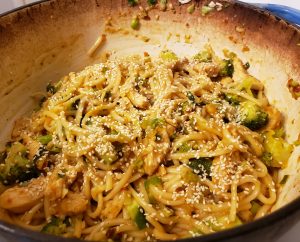
I still want more; it disappeared too fast.

Here’s what I did:

Ingredients

  • 14 oz. udon noodles, cooked to package directions
  • 1 lb. chicken, sliced or chopped
  • 3 c. broccoli (or about one grocery store package with 2 to 3 heads), chopped
  • 1 bunch green onions, white and light green parts sliced
  • ⅓ to ½ c. soy sauce (less sodium is good)
  • ¼ c. toasted sesame oil
  • 1 ½ T. ginger, minced (I used the jar stuff)
  • 3 cloves garlic, minced
  • 1 T. rice vinegar
  • Sambal oelek (chili paste), or Sriracha, to taste (I used about ½ T.)
  • 3 T. sesame seeds
  • Vegetable oil, for sauteing

Directions

Heat the oil in the Dutch oven over medium heat, and saute the chicken until mostly cooked through before adding the broccoli and green onions, stirring occasionally. Meanwhile, mix together the soy sauce, sesame oil, ginger, garlic, rice vinegar, and sambal oelek or sriracha, and stir to combine.

Once the chicken is cooked through and the vegetables are cooked to desired consistency, turn off stove top and add the sauce. Stir to combine and then add the cooked noodles, and continue stirring. Remove from heat and add the sesame seeds, stirring again. Taste and add more soy sauce or sesame oil as desired, and enjoy!

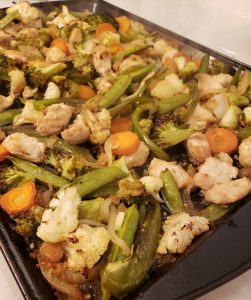
Stir Fry-day!!!

You guys, I’m not going to lie, it’s been a bit of a week.

It was one where I could not eat for a day and a half, and that had nothing to do with the sh*tshow in DC that may well decide the future of the court for the next generation.

All of it’s enough to make you want to weep, and believe me, it’s not been easy keeping a straight face. Fortunately, there’s wine.

And, mercifully, this week’s recipe calls for using some white wine, so enjoy the leftovers while trying to hold on to your last bit of sanity. It reminds me of my favorite quote.

My stir fry recipe, I think, is from Cook’s Illustrated. It’s one of those recipes that was printed more than a decade ago, put into a plastic sleeve, and has been used ever since. The Christinia that printed it is quite a bit different from that one. But the recipe persists.

Sheet pan stir fry ingredients.

It’s not quite comfort food. It’s relatively healthy. It’s not something I grew up on. But it’s the kind of recipe that bends to suit what one’s feeling at any given time. Like, this time, I made it with chicken but I’ve enjoyed it with tofu or just the veggies.

I usually cook it on my pseudo wok, but I saw from things I’ve made so far this year that cooking veggies and chicken on a sheet pan would be fine. Basically, it’s hard to mess up

Also, did I mention that the sauce includes wine *and* ginger?! It’s pretty amazing.

Wine *and* ginger, you say? Delicious.

Here’s what I did to enjoy my stir fry on a sheet pan:

Ingredients

For the sauce:

  • 4 T. soy sauce
  • 4 T. dry white wine or cooking sherry
  • 1 T. honey
  • ¼ c. minced ginger (I use the jar, but if you’ve got the patience for ginger root, please do!)
  • 4 to 5 cloves garlic, minced (Again, I’m lazy and used a couple teaspoons of the jar stuff)
  • 4 scallions, sliced white and light green parts

For the stir fry:

  • Combination of veggies, approximating 2 lbs. Mine was a combination of cauliflower, broccoli, carrots, sugar snap peas, green peppers, and onions. (For a better estimate, I used less than a quarter of a cauliflower, 2 heads of broccoli, 1 large carrot, about 1 bag of Dole sugar snap peas, one pepper, and one onion)
  • 1 lb. chicken, cut into ½ inch chunks, marinated in about ⅓ of the sauce
  • Remaining slices of scallions, added near the end of cooking time
  • Oil, for generously greasing the sheet pan
  • Rice, for serving

Directions

Mix the sauce. Prepare the chicken by putting the chicken chunks in a bowl and topping with about a quarter of the sauce.

Meanwhile, chop the remaining vegetables into bite-size pieces.

Heat the oven to 400 degrees, and generously grease a large sheet pan.

Add the vegetables to the sheet pan, and coat with about ½ of the remaining sauce. Cook for about 10 minutes. Create an opening on the sheet pan and add the marinated chicken. Top with more sauce. Bake another 15 to 20 minutes until the chicken is cooked through (I used an electric thermometer and it took longer, but safety first when it comes to eating meat!).  Remove when close to ready to serve, and add the remaining scallions and the rest of the sauce. Bake for another 5 minutes.

Remove from oven, let cool slightly, and enjoy with rice!

Chickity China the Chinese chicken

I like cheese way too much to make Asian food a staple of my diet. But it’s great to occasionally expand my palate and eat (somewhat) healthier fare. So, that is how I came to have a wide variety of Asian condiments in fridge door.

This week’s recipe thankfully allowed me to use so many of them and not add to my collection. I had bought some chicken thighs a weekend earlier when I made my venture to Whole Foods for seafood, so my purchases for this one amounted to three items.

Cauliflower, a sweet potato, and a red pepper were all it took to complete the sheet pan hoisin sriracha chicken recipe I had found a few weeks earlier from Taste of Home.

Hoisin sriracha chicken ingredients.

I mostly followed the recipe, except I’m lazy and used boneless, skinless chicken thighs. I might have added more sriracha because I didn’t measure it but it was damn spicy so add carefully or taste the sauce before pouring on the meat and vegetables.

I have to say I enjoyed it thoroughly, but my favorite thing was perhaps just how simply it came together.

I made it when we had the “fake fall” this past weekend, so I prepped the vegetables, made the sauce, and then sat in front of our firepit for a while before coming back to put it all together. About 45 minutes later, we had dinner, and a couple days worth of leftovers.

Don’t let the cauliflower fool you, this meal is flavorful and delicious.

Here’s what I did:

Ingredients

  • ⅓ c. hoisin sauce
  • ⅓ c. soy sauce (preferably low-sodium but we had regular on hand)
  • 2 T. honey
  • 2 T. sriracha (I didn’t measure but perhaps it’s best to measure on your taste for spicy foods)
  • 1 T. rice vinegar (I was out of rice wine vinegar, which I planned to use, so I used apple cider vinegar)
  • 2 t. sesame oil (I definitely used more but I love sesame oil)
  • 2 cloves garlic, minced
  • 1 t. minced fresh ginger
  • 6 boneless, skinless chicken thighs
  • Salt and pepper, to taste
  • 1 medium sweet potato, cut into cubes
  • 4 c. fresh cauliflower, cut into bite-size pieces
  • 1 red bell pepper, chopped
  • Sesame seeds, optional for topping
  • Oil for coating

Directions

Heat oven to 400 degrees.

Mix together the first eight ingredients, the hoisin sauce through the ginger, in a small bowl. Line a large rimmed sheet pan with aluminum foil and coat with a layer of oil (I use the spray kind). Place the sweet potato and chicken on prepared sheet pan, and add salt and pepper to taste.

Brush on about ⅓ of the hoisin sauce mixture.

Bake for about 15 minutes. Add the cauliflower and red pepper, and brush on another ⅓ of the hoisin mixture.

Bake another 25 to 30 minutes longer, until the chicken is cooked through. Brush on the remaining sauce, add the sesame seeds  (if using), and enjoy!

The recipe that convinced me to cook with tofu

I discovered the joys of tofu as a college student trying Thai food for the very first time. But I could never really figure out how to cook the tofu so that it came out like the wonderful pad see-ew or Pad Thai I got at restaurants. If I’m honest, I still haven’t mastered it.

So, instead, I’ve found an alternative way to make tofu that tastes amazing, has a million uses, and yes, even works in noodle dishes. That’s right; it’s baked tofu.

Baked tofu ingredients.

The thing is frying tofu just right is very difficult, but baked tofu is about impossible to mess up.

Plus, it comes pre-flavored with the saltiness of soy sauce and the spiciness of sambal oelek. Oh, and there’s wine. And that, combined with time, is about all it takes to transform the flavorless, spongy soy protein into something that is good enough to eat by itself.

I couldn’t even tell you where I initially found the recipe, but I know the blog post similarly raved about the ease. And frankly, I think I added the sambal oelek. I just know that I make it often enough, and it’s easy enough that this is the first time I’ve written it down.

My favorite uses for it are for spring rolls, stir fry (but keep it separate, otherwise it absorbs the liquid), and simple vegetable wraps. But options are endless as long as you have the delightful base.

I used these little guys to make *both* spring rolls and stir fry this week. Yum!

Here’s what I did:

Ingredients

  • 1 (18 oz.) container tofu (extra firm is preferred but firm will work in a pinch)
  • ¼ c. soy sauce
  • ¼ c. white wine (or water, or cooking sherry)
  • 1 heaping T. sambal oelek (usually found in the Asian section, or Sriracha will work in a pinch)
  • 1 T. sesame oil (optional)
  • Canola oil

Directions

Open and drain the tofu. Then, press it to drain more of the liquid for at least an hour. I’ve worked out a system where I use the sheet pan as the catch for the excess liquid, then place an upside-down rounded plate on top of the sheet pan, put the tofu on the plate, and then use a heavy lid like for a Dutch oven or another plate with a weight on top to press the tofu. (This can also be done a day in advance, and store the drained tofu in a Tupperware.)

Once the tofu is strained, cut it into 15 to 20 long slices. Again, I use the overturned plate to do my cutting so I don’t dirty more dishes.

Heat the oven to 325.

Then, mix together the soy sauce, wine, sambal oelek and sesame oil, if using.

Rinse and dry the sheet pan, and then coat it with canola oil. Place the slices of tofu on the sheet pan in a single layer. Brush on about half of the soy sauce mixture, and let sit for 5 minutes so the tofu absorbs most of the flavorful liquid, Turn over the slices carefully, and brush the remaining sauce on the other side. Let it absorb into the tofu for another 5 minutes. It’s OK if not all the liquid absorbs.

I usually spray with a little more oil because I’m paranoid it’ll stick.

Bake the tofu for 15 minutes, take out of the oven, and *carefully* flip over the slices. Bake for another 15 to 20 minutes until nice and browned and the liquid absorbed. Let cool slightly, and enjoy!