Since the pandemic began, apparently people have been getting into bread baking. Not only are there the news stories but I have the anecdotal evidence that my sweetie had trouble finding active dry yeast during one of his recent weekly grocery trips.
However, for once, I was ahead of the curve. I have been making bread on the regular for years. And since my sweetie did go to a second store for the yeast, I am back in business now after nearly using up my stash when I made pizza a couple weeks ago.
I do get why it’s picked up in popularity, as it’s often cheaper especially than some fancier breads, and it’s a good distraction for a few hours. Those brave souls who nourish sourdough starters — which I did for a while during my bread year and beyond but didn’t survive the move to Ames — are even giving themselves ongoing time commitments.
What I’m saying is, like Oprah, I love bread.

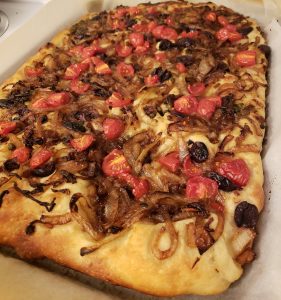
One of my favorites is focaccia. What’s not to love about a lot of olive oil, and for me, the addition of olives and/or rosemary. While I’ve made this many times before, I couldn’t recall ever making it in a small skillet.
Thankfully, the wonderful Serious Eats had a no-knead (even better!) recipe that was designed for a 10-inch skillet. I figured my 9-inch Le Creuset would work after reading the directions. It did, but barely. I ended up with a much poofier loaf than anticipated; however, another thing I did wrong among expert breadmakers is I neglected the preferred weight measurements and instead went with the also provided cup measurements. In the end, I needed more water than the recipe called for, which likely means I used too much flour and ended up with a bigger loaf than I would have otherwise.
I could beat myself up about it … but in the end, there’s just more bread to love.
Though I’m sure weighted measurements are preferred (and given) for all but my additions, this still-somewhat-lazy baker would probably worry mostly about the flour and the water measurements in weights.

Here’s what I did, adding my own tweaks:
Ingredients
- 500 g. bread flour or all-purpose flour (~3 ¼ c.)
- 10 g. kosher salt (~2 ½ t.)
- 4 g. active dry yeast (~1 rounded t.)
- 400 g. room temperature water (1 ½ c. plus 3 T.)
- 68 g. olive oil (~5 T.), divided
- ~3 sprigs rosemary, divided
- ½ c. pitted kalamata olives, chopped
- Coarse sea salt
Directions
Combine the flour, salt, and yeast in a large bowl and whisk to blend. Add the water and stir with a wooden spoon until no dry flour remains, about 2 minutes (if you measured by cups, you may need to add additional water to combine). Add about 1 ½ T. (20 g.) olive oil and stir to incorporate, using hands if necessary to work into the dough. Cover with plastic wrap and let rest at room temperature for 1 hour.
Remove plastic wrap (but keep!), and add about 2 sprigs worth of rosemary leaves, chopped if desired and all the olives. Then, use a lightly greased bowl scraper to fold the dough over itself by lifting and folding the edge of the dough toward the middle. Turn bowl and repeat the motion another 5 times (which should also help combine in the rosemary and olives). Re-cover with the plastic wrap and let rest for 15 minutes. Repeat the folding process one more time, and re-cover with the plastic wrap.
Then, refrigerate for at least 18 hours and up to 3 days.
To bake, remove the dough from the refrigerator and let sit at room temperature for 10 minutes. Sprinkle the top of the dough lightly with flour, and then transfer to a work surface, and shape holding it with well-floured hands, tucking the dough underneath itself and rotating until it forms a tight ball.
Add about 2 T. (27 g.) olive oil into a 9- to 10-inch cast iron skillet and spread the oil over the entire inner surface using your hands. Transfer the dough to the pan, turn to coat it in the oil, and then position seam-side down. Spread gently with your hands to mostly fill the pan. Cover tightly and let rise at room temperature until dough is soft and puffy, about 1 ½ hours to 2 hours.
Heat oven to 500 degrees and position the rack in the lower third of the oven, when the dough is nearly ready.
Use your fingertips to gently press and stretch the dough to evenly fill all corners of the pan, lifting up the edges of the dough to let air bubbles underneath escape, and then create small dimples in the top of the dough. Drizzle the remaining 1 ½ T. (20 g.) olive oil over the top of the dough, and then sprinkle with coarse sea salt and the leaves from the remaining sprig of rosemary.
Transfer skillet to oven and bake for about 20 to 25 minutes, rotating the skillet about halfway through the baking. (It seems hot, and I deviated from the directions here since I didn’t have a baking stone, but it works with some light charring on top but perfectly golden on the bottom; however, keep a closer eye on times given the high heat.) Remove from heat and let the focaccia cool in the skillet for 5 minutes, and then use a spatula to carefully remove the focaccia from the still-hot skillet and transfer the bread to a wire rack. Let cool at least 10 minutes before serving, and enjoy!